Coin Collection on Shifting Ground
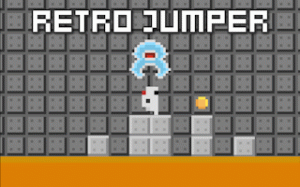
The objective in Retro Jumper: Pixel Coin Runner is straightforward: gather as many falling coins as possible before hazards catch up. Coins appear both on platforms and in mid-air, so grabbing them often means jumping into open space rather than staying on solid ground. Platforms themselves move and shift, turning every coin run into a timing problem. The lava pits along the bottom of the screen enforce a hard boundary — one mistimed landing ends the attempt.
Why Standing Still Backfires
Most platformers let you pause and plan. This one punishes hesitation. Lingering too long on any platform can cause an obstacle to appear, which means the safest strategy is also the most active one. Players who treat each platform as a temporary checkpoint rather than a resting spot tend to last longer. That single design choice reshapes the whole experience: it rewards forward momentum, quick reads of the environment, and decisive jumps over cautious play.
Controls and Difficulty Curve
Movement uses keyboard input, typically arrow keys or WASD, with jumping mapped to a separate key. The scheme is simple enough that new players can start within seconds, but the difficulty ramps as more coins spawn and platform movement grows more erratic. Early runs feel forgiving; later ones demand precise reflexes. Best-score tracking gives players a concrete way to measure whether their timing is actually improving.
Who This Suits
Short session length makes Retro Jumper a natural fit for players who want a quick arcade fix rather than a long campaign. The pixel art and retro sound effects target nostalgia, but the escalating challenge keeps it from being purely decorative. Anyone comfortable with classic platformer timing will recognize the rhythm immediately; newcomers may need a few runs to internalize the anti-idling rule.










Editorial Notes