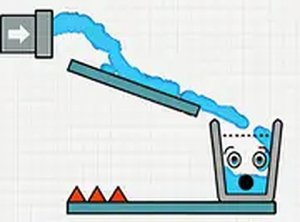
The Core Water-Filling Mechanic
Every stage in Liquid Logic: Glass Filling Challenge gives you one clear objective: move water from its source into a glass and stop at the exact target line marked on the container. Water flows, splashes, and reacts to whatever stands in its path, so the challenge is not just getting liquid into the glass but controlling how much arrives. A pour that is too fast or angled poorly can overshoot the mark or spill entirely, forcing a restart.
Obstacles That Reshape Each Puzzle
What separates one level from the next is the layout of barriers and channels between the source and the glass. Early stages use simple walls that need only a gentle tilt to redirect the flow. Later puzzles introduce moving platforms, narrow passages, and elements that absorb or divert liquid. Because these obstacles change how water travels, you need to study the arrangement before acting rather than pouring immediately.
Visual Style and Browser Accessibility
Bright blues and greens dominate the palette, and smooth animations give the water a lively, readable quality. The interface stays clean and uncluttered, keeping attention on the puzzle. The game runs entirely in a web browser with no installation or updates, and it supports both touch and mouse controls, so it plays naturally on phones, tablets, and computers. Full-screen mode is available for a distraction-free view.
Progression and Difficulty Curve
Complexity builds gradually. New obstacle types appear at a steady pace, letting you understand one water-physics behavior before the next is added. A simple pour early on becomes a series of decisions about timing, angle, and flow rate. The ramp is designed to encourage repeated attempts rather than frustrate, so refining your approach is part of the process.







Editorial Notes